Lithospheric Structure Beneath the Sea of Japan
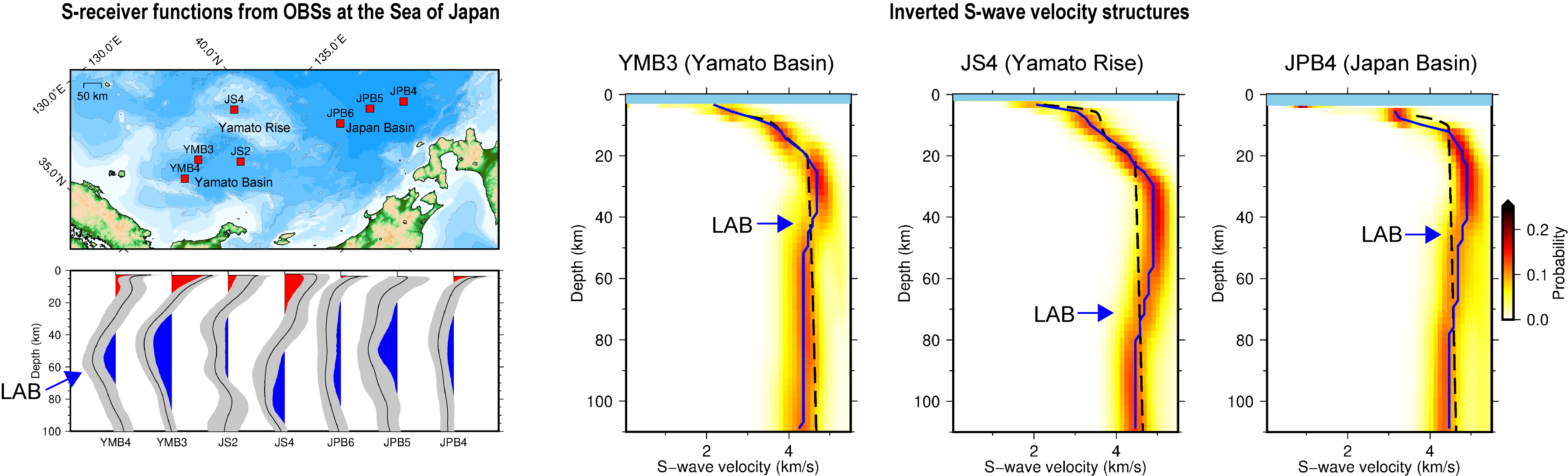
The formation of the Sea of Japan is closely related to the evolution of the Japanese Islands. However, its formation process remains controversial, and many aspects are still poorly understood. By analyzing seismic data recorded by ocean-bottom seismometers, we aim to investigate the lithospheric structure of the oceanic plate and thereby shed light on the formation history of the Sea of Japan.
Passive Seismic Network of Ocean-Bottom Seismometers
As part of the Ministry of Education–commissioned project, “Sea of Japan Tsunami and Earthquake Research Project,” ocean-bottom seismometers were deployed in the Yamato Basin between 2013 and 2016. These data are currently under analysis. Since 2017, seismic observations have been extended to the Japan Basin, and the first dataset was recovered in 2018.
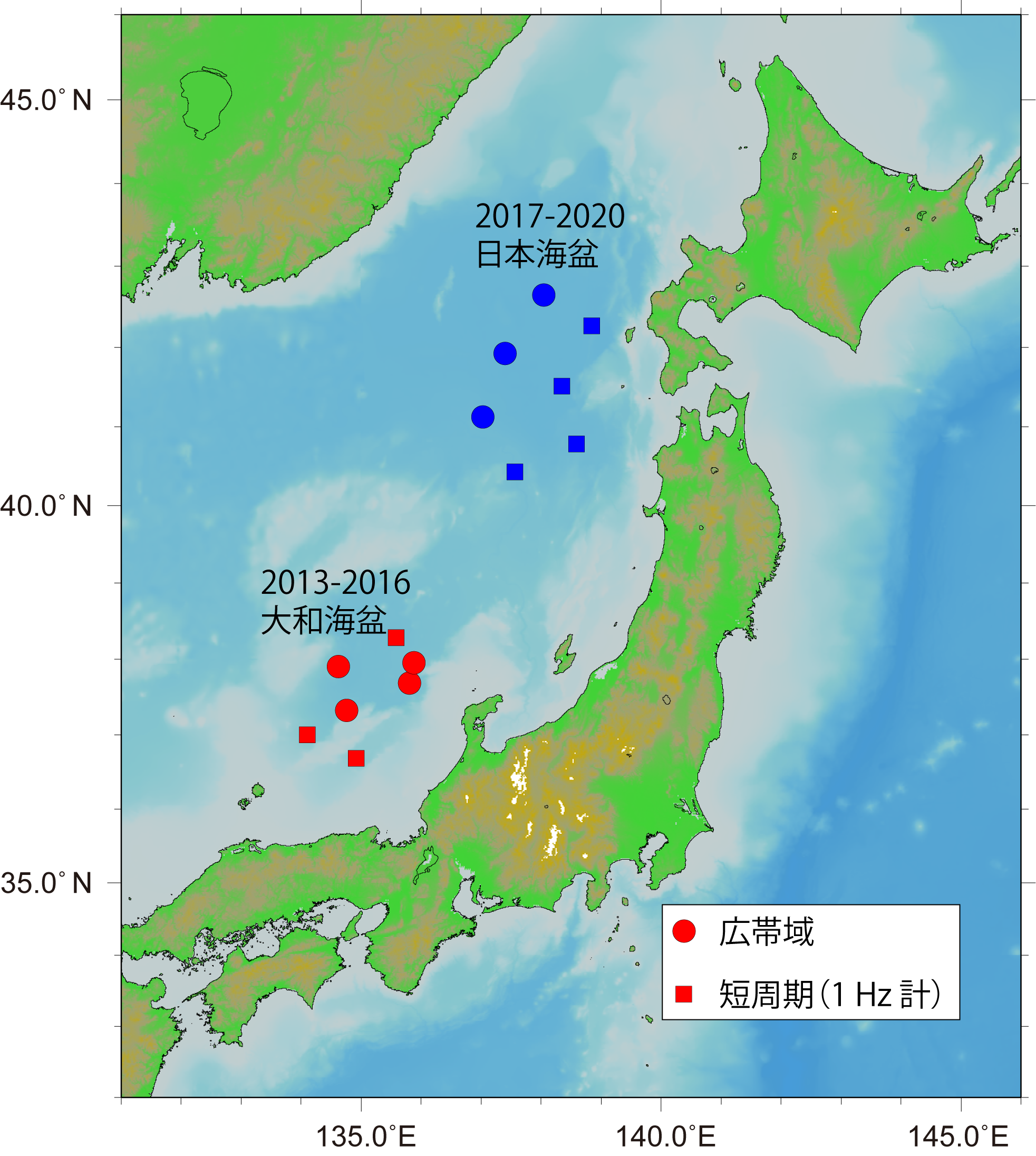
Figure 1. Passive seismic network of ocean-bottom seismometers.
Detection of the Lithosphere–Asthenosphere Boundary
One of the most fundamental properties of an oceanic plate is its thickness. Estimating plate thickness provides key constraints on the thermal structure and formation process of the plate. In the case of the Sea of Japan, such information is also expected to contribute to seismic hazard assessment. The base of the plate is referred to as the lithosphere–asthenosphere boundary, where a significant contrast in rock rigidity, or equivalently seismic wave velocity, is expected. We aim to extract seismic phases reflected or converted at this boundary from ocean-bottom seismometer data in order to constrain the lithospheric structure beneath the Sea of Japan.