Slow Earthquakes in the Kumano-nada Region
The Kumano-nada region, located south of the Kii Peninsula, is an area of active seismicity.
In particular, slow earthquakes—events that release energy over longer durations than regular earthquakes—
frequently occur in this region. These phenomena are thought to represent slow fault slip along
plate boundaries and are governed by mechanisms distinct from those of ordinary earthquakes.
Using dense observations from ocean-bottom seismometers (OBSs), we investigate the mechanisms
of slow earthquakes in the Kumano-nada region and their relationship with subsurface structure.
Our goal is to clarify the conditions under which slow earthquakes occur and to understand how
they differ from regular earthquakes.
Development of a Method for Locating Tectonic Tremors
Tectonic tremors are a type of slow earthquake characterized by continuous seismic signals
lasting for several minutes. We have developed a new method to accurately determine the
locations of these tremors.
The proposed method utilizes not only arrival-time information but also amplitude information
of seismic waves. In addition, a probabilistic framework based on Bayesian statistics is employed,
enabling more accurate estimation of tremor source locations compared to conventional methods.

Figure 1: Spatial distribution of tectonic tremors estimated using the new method.
Structural Controls on Slow Earthquake Slip
Based on the spatial distribution of tectonic tremors, we investigate structural factors that control slow earthquake slip. Our results indicate that features such as fault bending and mechanically strong rocks in the overriding plate can act as barriers that limit fault slip.
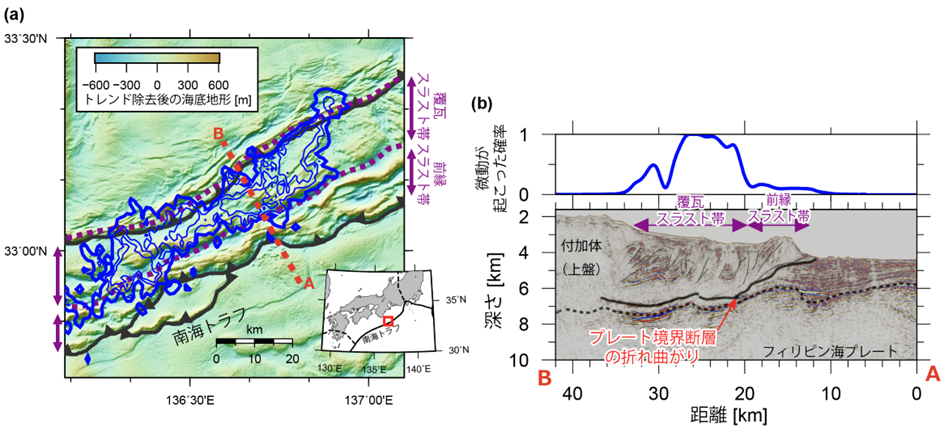
Figure 2: Relationship between tectonic tremor distribution, bathymetry, and subsurface structure.
References
- Akuhara, T., Yamashita, Y., Sugioka, H., & Shinohara, M. (2023). Locating tectonic tremors with uncertainty estimates: time- and amplitude-difference optimization, wave propagation-based quality control and Bayesian inversion. Geophysical Journal International, 235(3), 2727–2742. https://doi.org/10.1093/gji/ggad387
- Akuhara, T., Shiraishi, K., Tsuji, T., Yamashita, Y., Sugioka, H., Farazi, A. H., et al. (2026). Structural barriers control the spatial extent of slow earthquake slip. Nature Communications. https://doi.org/10.1038/s41467-025-68179-1