Receiver Function Analysis Using Ocean-Bottom Seismometers
Receiver function analysis is a signal processing technique that extracts information on Ps converted waves originating from subsurface discontinuities such as the Moho and plate boundaries, using P-wave recordings from distant earthquakes. This method has been well established since the 1970s and is now widely applied to waveform data recorded by onshore seismometers. However, waveform data from ocean-bottom seismometers (OBS) present unique challenges, and receiver function analysis has not been widely applied to such data. We are developing methods to enable accurate receiver function analysis using OBS data.
Water-Layer Reverberations in the Vertical Component of OBS Data
In contrast to onshore stations, the vertical component of teleseismic P-wave recordings at ocean-bottom seismometers contains waves that are multiply reflected between the sea surface and the seafloor. When such water-layer reverberations contaminate the vertical component, it becomes difficult to correctly compute receiver functions. The upper four traces in Figure 1 show teleseismic waveforms recorded at four OBS stations deployed offshore the Kii Peninsula. The bottom trace represents the stacked waveform recorded at onshore stations in Japan for the same event. A comparison reveals that strong reverberations, indicated by red triangles, are present in the OBS records.
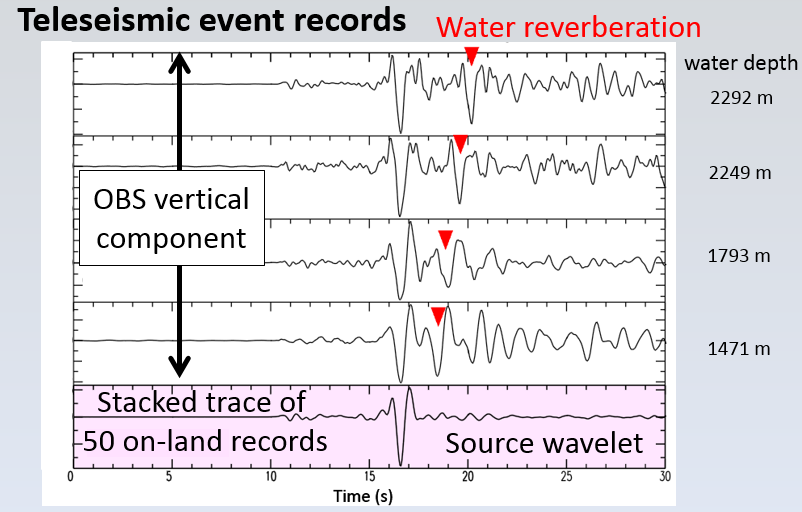
Figure 1: Teleseismic waveforms recorded by ocean-bottom seismometers
Development of a Filter to Remove Water-Layer Reverberations
Water-layer reverberations can be expressed in a mathematically simple form under several assumptions. Here, “simple” means that only a small number of parameters are required. Figure 2 shows the actual formulation, which involves only two parameters: (1) the reflection coefficient of P-waves at the seafloor, and (2) the two-way travel time for a P-wave within the water column. This formulation can be interpreted as a filter that reproduces water-layer reverberations. Conversely, by removing this filter from OBS recordings, we can generate waveforms free from the effects of water-layer reverberations.
Reference: Akuhara, T., and K. Mochizuki (2015), Hydrous state of the subducting Philippine Sea plate inferred from receiver function image using onshore and offshore data, J. Geophys. Res. Solid Earth, 120(12), 8461–8477, doi:10.1002/2015JB012336.
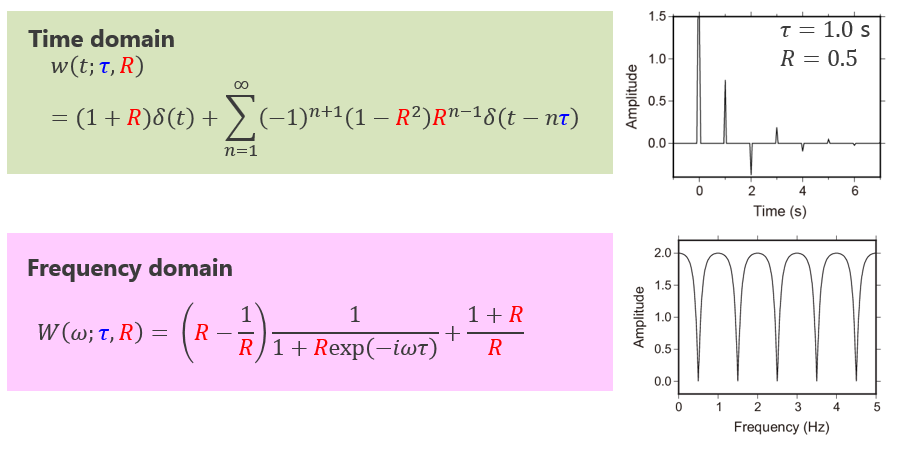
Figure 2: Mathematical expression of water-layer reverberations
Receiver Functions After Removing Water-Layer Effects
By removing water-layer reverberations from the vertical component of teleseismic P-waves, receiver functions can be computed correctly. This has been verified through numerical simulations. In Figure 3, receiver functions calculated using the conventional method (gray lines) are compared with those obtained after removing water-layer reverberations (red lines), using synthetic OBS data. Blue vertical lines indicate the theoretical arrival times of converted and reflected waves. The receiver functions obtained with the new method (red lines) successfully reproduce peaks at the expected arrival times, whereas the conventional method (gray lines) fails to do so. This demonstrates the effectiveness of the proposed approach.
Reference: Akuhara, T., K. Mochizuki, H. Kawakatsu, and N. Takeuchi (2016), Non-linear waveform analysis for water-layer response and its application to high-frequency receiver function analysis using OBS array, Geophys. J. Int., 206(3), 1914–1920, doi:10.1093/gji/ggw253.
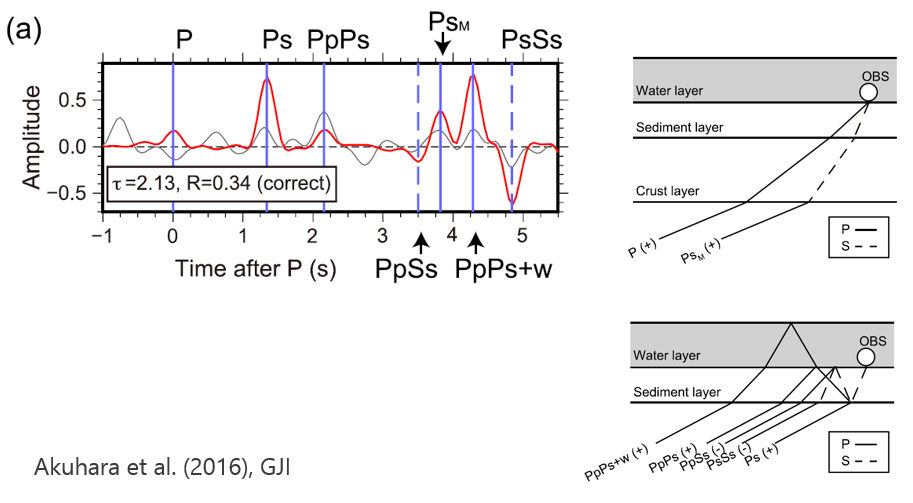
Figure 3: Numerical experiment of receiver function analysis
Acknowledgements
This study was supported by JSPS KAKENHI Grant Number JP14J10221.