Development of Next-Generation Receiver Functions
Receiver function analysis, widely used in seismology, has limitations in high-frequency analyses and in applications to ocean-bottom seismometer (OBS) data, where strong reverberations from the ocean surface are present. In this study, we propose a new method based on Bayesian statistics to overcome these limitations.
Advantages over Conventional Methods
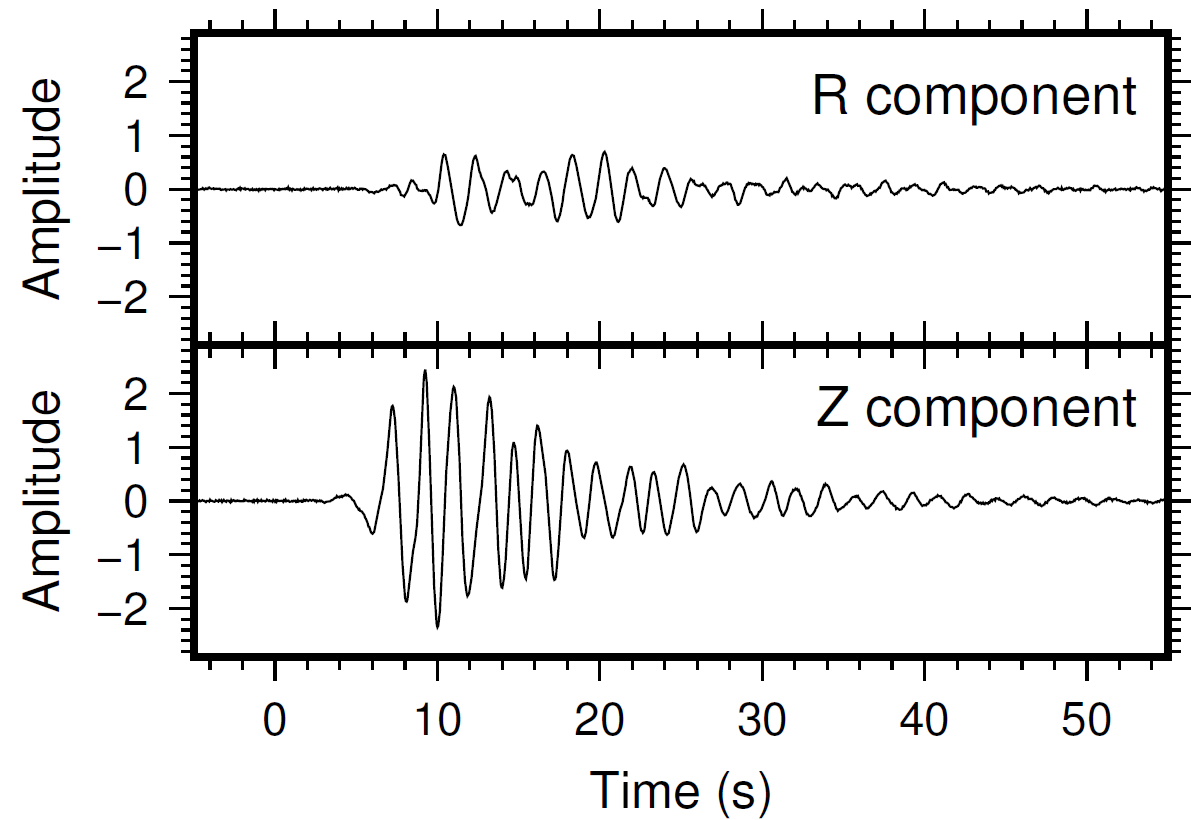
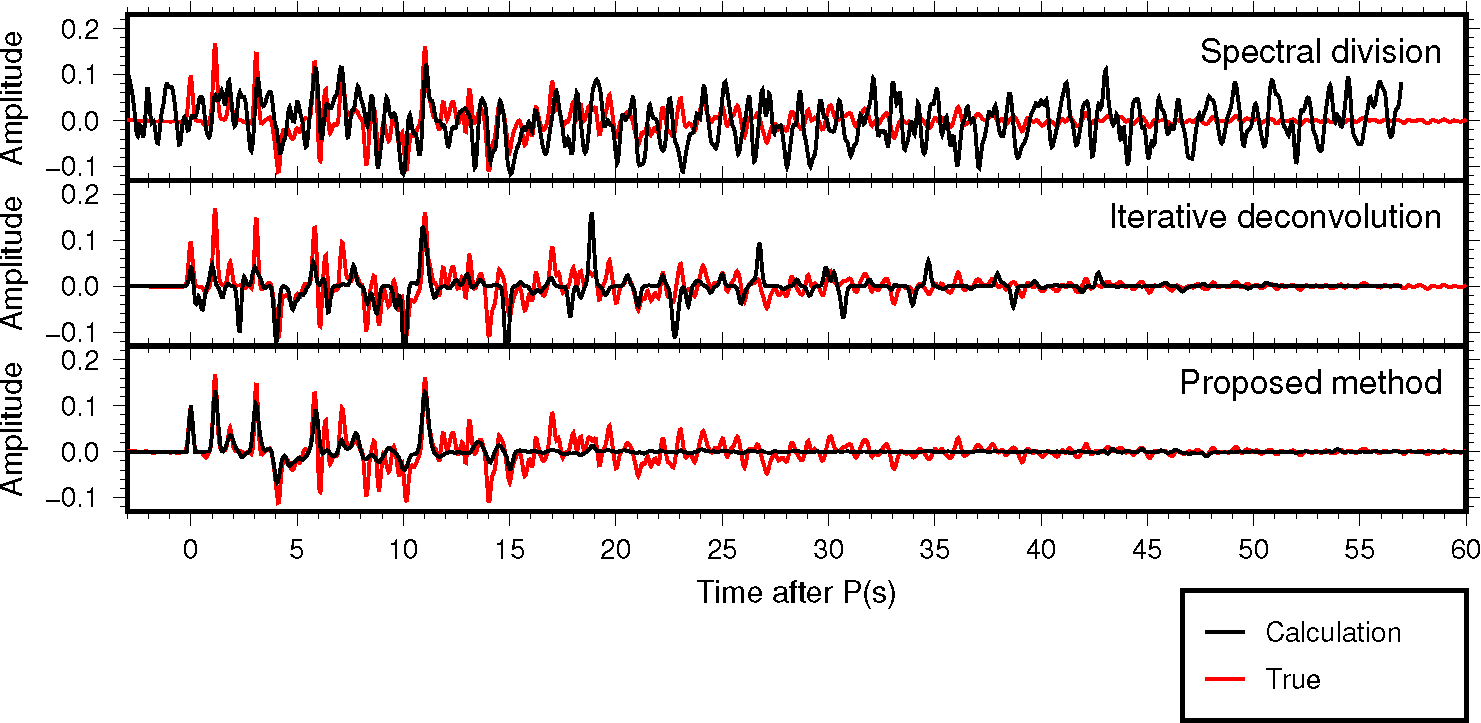
The lower-left figure shows synthetic waveform data that mimic OBS recordings. From these input data, we attempt to extract information about subsurface structures. The lower-right figure presents the results obtained using various methods. The top two rows correspond to conventional approaches, while the bottom row represents the newly developed method. A method is considered better when the computed waveform (black line) more closely matches the true waveform (red line).
Input Waveform
Results – Comparison of Methods
Application to Observational Data
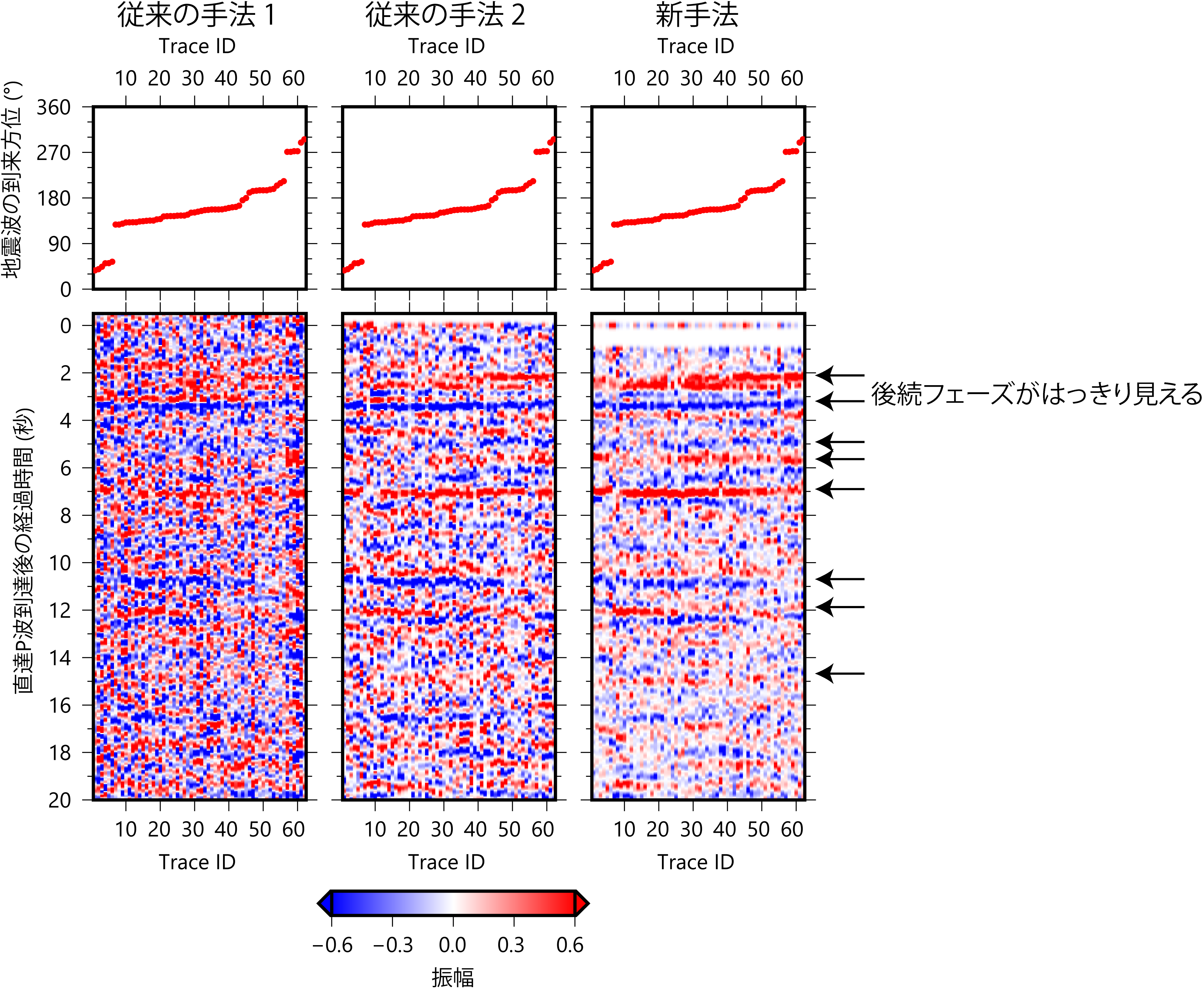
We applied both conventional methods and the newly developed approach to OBS data deployed in the Sea of Japan. The figure below shows processed waveforms from earthquakes at various locations, displayed with amplitude-based color coding. In the results obtained with the new method, later phases that are difficult to identify using conventional approaches become clearly visible. These phases represent converted and reflected waves originating from subsurface discontinuities. By utilizing these newly resolved phases, we can obtain more detailed constraints on subsurface structures.
Application to Observational Data
References
- Akuhara, T., Bostock, M. G., Plourde, A. P., & Shinohara, M. (2019). Beyond Receiver Functions: Green's Function Estimation by Trans‐Dimensional Inversion and Its Application to OBS Data. Journal of Geophysical Research: Solid Earth, 124. https://doi.org/10.1029/2018JB016499