

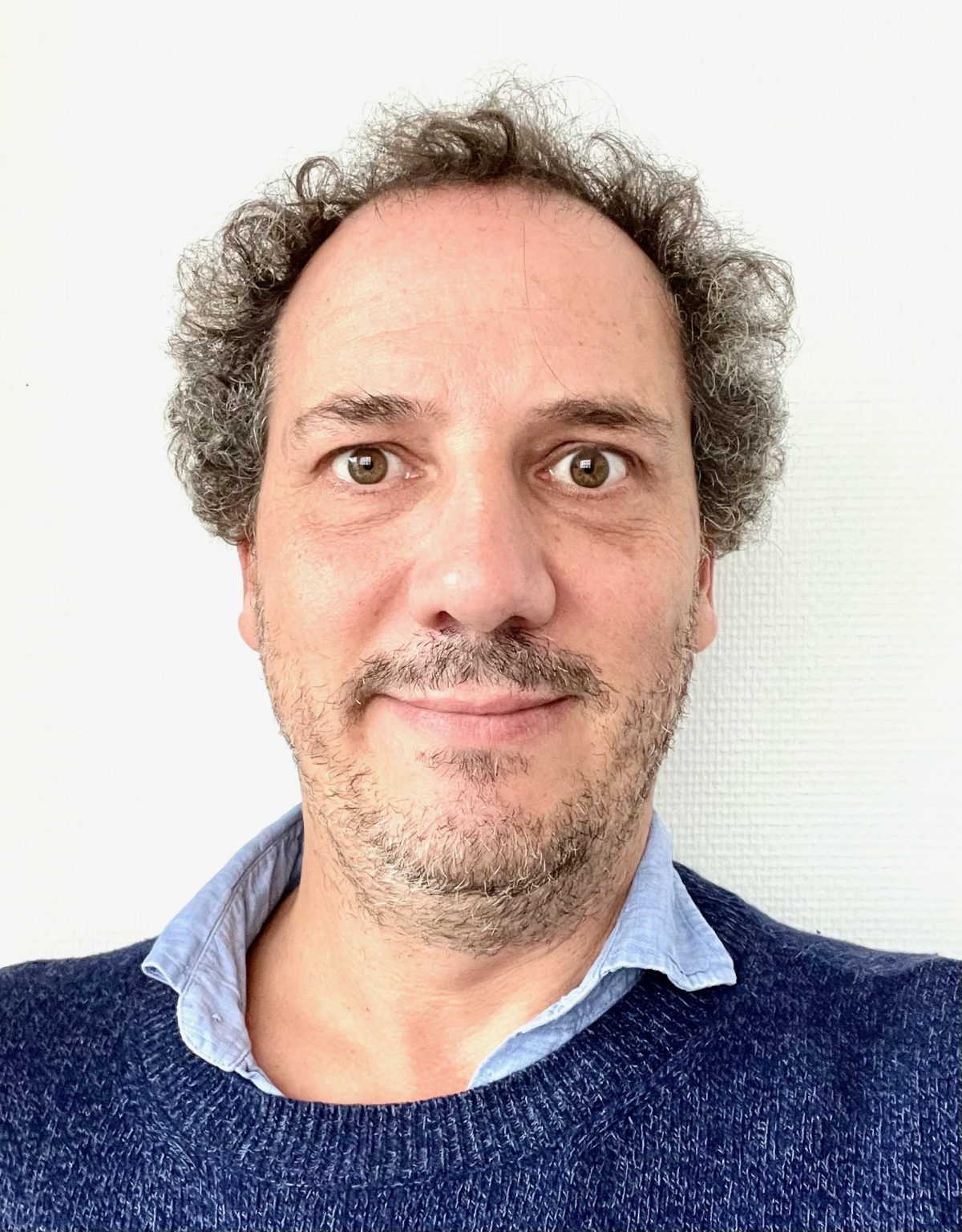
Title: Senior Scientist at CNRS
Country/Region: France
Period: 2024/9/1-2025/2/15
Theme: Earthquake nucleation: from the laboratory to the field
Host: Aïtaro KATO
Introduction: Dr. Alexandre Schubnel received his Masters and PhD. in Geophysics from the Institut de Physique du Globe de Paris in 1999 and 2003 respectively. After a postdoctoral fellowship at the University of Toronto (2003-2006), he was appointed as a junior scientist at CNRS in 2006. He is currently a senior scientist at CNRS, the department head at the Laboratoire de Géologie of Ecole Normale Supérieure de Paris and the editor in chief of the Journal of Geophysical Research - Solid Earth. His research focuses on rock and fracture mechanics, mixing experimental and theoretical approaches, in order to better understand the physics of earthquake processes.
Research Report:
Summary: My research report for this 5 months and half visiting professor position at ERI has three-folds:
1 - Revisiting the nucleation phase of Japanese earthquakes (with Prof. Aïtaro Kato)
2- Produce synthetic samples for high-pressure experiments (with prof. T. Hiraga)
3 – Interactions with colleagues, discussions and further collaborations
1 - Revisiting the nucleation phase of Japanese earthquakes (with Prof. Aïtaro Kato)
The predictability of earthquakes has been debated since many decades. Recent progress of analyses both on the field data and laboratory experiments highlight a nucleation process before large earthquakes such as the 2011 Tohoku [1] and other earthquakes (e.g. [2]). Recent experimental studies suggest if the earthquake nucleation process starts as a fully aseismic process, it evolves towards a cascading process at the onset of dynamic rupture [3]. This recent experimental work proposed a universal scaling for the inverse Omori law followed by the premonitory foreshock activity. In Japan, roughly 30-40% of earthquakes are preceded by foreshocks [4]. In that context, prof. Aitaro Kato gently gave me and my team in France access to the updated Japanese catalog by the JMA, from October 1997 to November 2024, with a total number of events being roughly 4.6 million, and a completeness magnitude of around ~1.5. Our idea is to follow the procedure of averaging presented by [3], in order to test the laboratory scaling at field scale. The scientific questions we will answer are the following:
1) Upon averaging foreshock-mainshock sequences, is there a characteristic (average) foreshock sequence that emerges, and if yes, how does it depend on mainshock magnitude, depth and focal mechanism (tectonic context).
2) If this average sequence does exist, we aim at defining variability, ie. standard deviation from the average, type of distribution, using standard statistical analysis and earthquake probability laws such as Omori and Gutenberg Richter (GR).
3) Finally and if possible, investigate possible outside forcing by tides during foreshock-mainshock-aftershock sequences.
1 - Revisiting the nucleation phase of Japanese earthquakes (with Prof. Aïtaro Kato)
2- Produce synthetic samples for high-pressure experiments (with prof. T. Hiraga)
3 – Interactions with colleagues, discussions and further collaborations
1 - Revisiting the nucleation phase of Japanese earthquakes (with Prof. Aïtaro Kato)
The predictability of earthquakes has been debated since many decades. Recent progress of analyses both on the field data and laboratory experiments highlight a nucleation process before large earthquakes such as the 2011 Tohoku [1] and other earthquakes (e.g. [2]). Recent experimental studies suggest if the earthquake nucleation process starts as a fully aseismic process, it evolves towards a cascading process at the onset of dynamic rupture [3]. This recent experimental work proposed a universal scaling for the inverse Omori law followed by the premonitory foreshock activity. In Japan, roughly 30-40% of earthquakes are preceded by foreshocks [4]. In that context, prof. Aitaro Kato gently gave me and my team in France access to the updated Japanese catalog by the JMA, from October 1997 to November 2024, with a total number of events being roughly 4.6 million, and a completeness magnitude of around ~1.5. Our idea is to follow the procedure of averaging presented by [3], in order to test the laboratory scaling at field scale. The scientific questions we will answer are the following:
1) Upon averaging foreshock-mainshock sequences, is there a characteristic (average) foreshock sequence that emerges, and if yes, how does it depend on mainshock magnitude, depth and focal mechanism (tectonic context).
2) If this average sequence does exist, we aim at defining variability, ie. standard deviation from the average, type of distribution, using standard statistical analysis and earthquake probability laws such as Omori and Gutenberg Richter (GR).
3) Finally and if possible, investigate possible outside forcing by tides during foreshock-mainshock-aftershock sequences.
View All
Fiscal Year: 2024
Fiscal Year: 2024