Osamu SANDANBATA1& ShunsukeTAKEMURA1
1. Earthquake Research Institute, The University of Tokyo
Sandanbata, O., & Takemura, S. (2025). Full‐spectrum similarity of repeating trapdoor faulting. Geophysical Research Letters, 52(24), e2025GL119615. https://doi.org/10.1029/2025gl119615
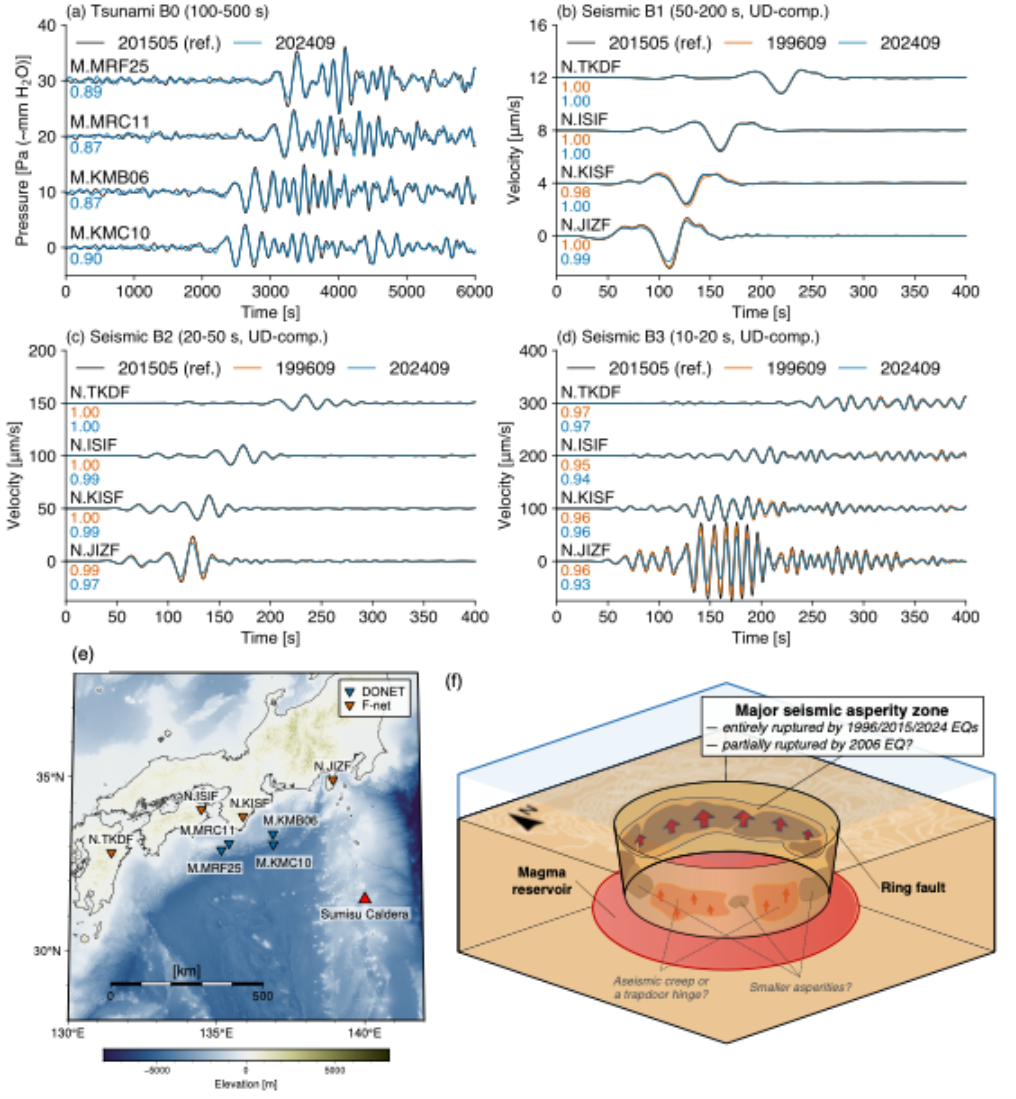
At Sumisu Caldera, a unique fault motion known as trapdoor faulting occurs repeatedly about every 10 years, each time generating earthquakes ofMw5.4–5.7accompanied by tsunamis (see Explanatory Article). During these earthquakes driven by sub-caldera magma pressure, the fault slips abruptly, causing significant uplift of the caldera, which in turn triggers tsunami generation. In this study, we compared seismic and tsunami waveforms over a broad period range(0.2–500s) for multiple earthquakes that occurred at Sumisu Caldera. We found that the three largest events exhibit highly consistent waveforms (Fig.1). This strong similarity indicates that the same largeseismic fault patch (asperity) ruptures during each event, and that its location and rupture process remain stable over decades. In contrast, smaller similar earthquakes show waveform differences, likely reflecting partial rupture of the main patch or activity of surrounding smaller patches. Furthermore, waveform comparisons of trapdoor faulting earthquakes at other submarine calderas also revealed high similarity. These observations suggest that, as at Sumisu Caldera, specific fault segments repeatedly rupture. However, recurrence intervals and earthquake magnitudes vary among calderas, reflecting differences in fault structure and frictional properties. Such studies provide important insights into the frequency and magnitude of recurring earthquakes and tsunamis at submarine calderas, as well as the mechanical state of the caldera.
ExplanatoryArticle: https://www.eri.u-tokyo.ac.jp/en/research/5323/