Abstract:
While submarine volcanoes account for over 70% of volcanism on Earth, their inaccessibility means that our understanding of their active processes remains limited. In this talk, I will first discuss the discovery of a type of seismo-acoustic event which allows the remote tracking of lava flow during submarine eruptions, as well as the most likely source mechanism of these impulsive seafloor events. Subsequently, I will present results from over a decade of continuous, real-time monitoring of Axial Seamount on the Juan de Fuca ridge in the Northeast Pacific Ocean such as the precursory processes leading up to its 2015 eruption, the magmatic and fault systems’ response to tidal loading, and the volcano’s evolution as it builds towards the next imminent eruption.
Title: Operator Learning in Seismology: AI for infinite dimensions
Abstract:
Seismology and geophysics are fields in which phenomena are typically described by partial differential equations, i.e. operators that map between infinite dimensional function spaces. However, deep neural networks are designed to work only on finite dimensional vector spaces. An immediate consequence is that deep neural networks are trained for a particular spatial/temporal discretization, and are unable to generalize to arbitrary mesh configurations. For example, suddenly increasing the spatial resolution by 1000x can break deep neural networks, even if the physics is the same at both scales. A recent machine learning paradigm called Operator Learning has developed a variety of Neural Operator models that naturally learn on function spaces, and provably generalize to irregular sensor geometries and arbitrary mesh resolution. This makes Neural Operators an excellent choice for many data-driven and simulation-based problems. In this talk, I will cover the fundamentals of Operator Learning and its importance to problems in seismology and geophysics. I will show applications to earthquake detection and picking; applications to seismic full waveform imaging; generative modeling of seismic ground motions, and more. I will highlight the advantages of using Neural Operators instead of Neural Networks for each of these problems. I will discuss why I believe Operator Learning will be a valuable part of Seismology in the future.
1IGE, Université Grenoble Alpes, France, 2ERI, University of Tokyo, Japan, 3ISTerre, Université Grenoble Alpes, France, 4ITES, Université de Strasbourg, 5School of Earth and Space Sciences, University of Science and Technology of China, 6Research Center for Prediction of Earthquakes and Volcanic Eruptions, Graduate School of Science, Tohoku University, Sendai, Japan
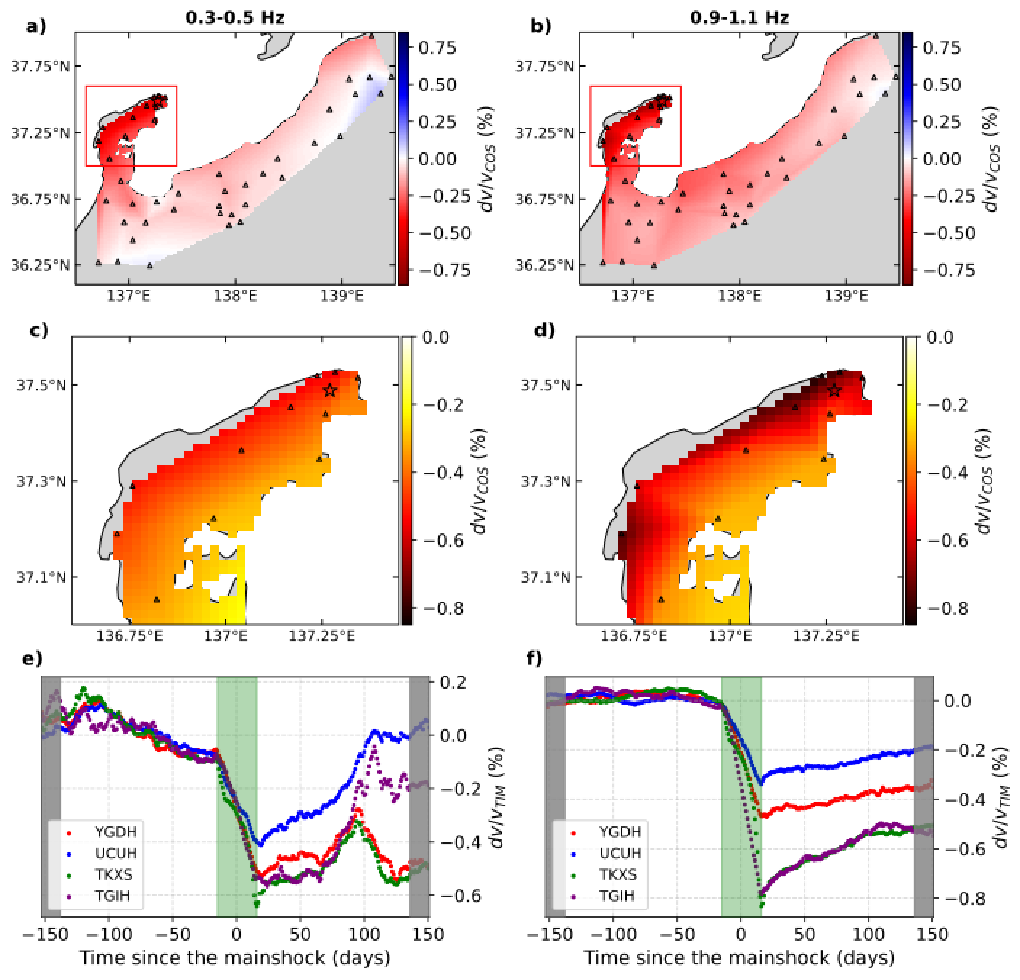
Coseismic crustal seismic velocity changes associated with the 2024 Mw 7.5 Noto earthquake, Japan Earth, Planets and Space, 77, 51 https://doi.org/10.1186/s40623-025-02177-x
2024年能登半島地震(M w 7.5)に先駆けて生じていた群発地震活動は、15km以深に存在していた流体が浅部へ上昇することで生じたと考えられている。地下の地震波速度は地震等に伴う外部からの応力擾乱に応答して変化することが知られており、地震波速度の変化量は地殻内流体の量に応じて増幅される。したがって、2024年能登半島地震のような大きな地震に伴う地震波速度の変化を検出することで、異常な量の地殻内流体の存在の有無を議論できると考えられる。そこで、本研究では常時微動を使った地震波干渉法解析を実施し、地震前後の地震波速度の変化を検出した。その結果、能登半島の直下においては、本研究の解析周波数帯が感度を持つ0.5kmから2.5kmの深さにかけて、平均0.5%程度、最大で0.6-0.8%程度の地震波速度の低下があったことが明らかになった(図)。大地震に伴う地震波速度変化は、地震波による動的な応力変化と、静的な応力変化によって生じるとされる。そこで、地動最大速度(PGV)と地動最大加速度(PGA)を動的な応力変化を示す量として動的な応力変化の観測された速度低下の寄与を議論した。また、モデル計算により静的な応力変化による速度低下を見積もった。その結果、PGV、PGA、静的な応力変化による速度低下のいずれもが観測された速度低下とよく相関していたため、どちらのメカニズムが観測された速度低下に支配的な影響を及ぼしていたかについては結論づけられなかった。PGV、PGA、静的な応力変化による速度変化と観測された速度変化の比較から、能登半島北東端の群発地震域における本震時の地震波速度低下量は、地殻内に異常な量の流体が存在すると解釈できるほど大きくなかったことがわかった。この結果は、2.5km以浅には異常な量の流体は貯まっていないこと、すなわち、本震前数年間に亘って上昇していたとされる流体の大半が2.5km以深に留まっていたことを示唆している。なお、本研究では、防災科学技術研究所による定常地震観測ネットワークの観測点に加えて、東京大学地震研究所並びに東北大学が設置した臨時の地震観測点のデータを加えて解析を実施した。臨時観測点は能登半島北東端に集中して設置されており、定常観測点のみの解析結果と比較して、その直下の地震波速度の解像度の向上に大きく貢献した。